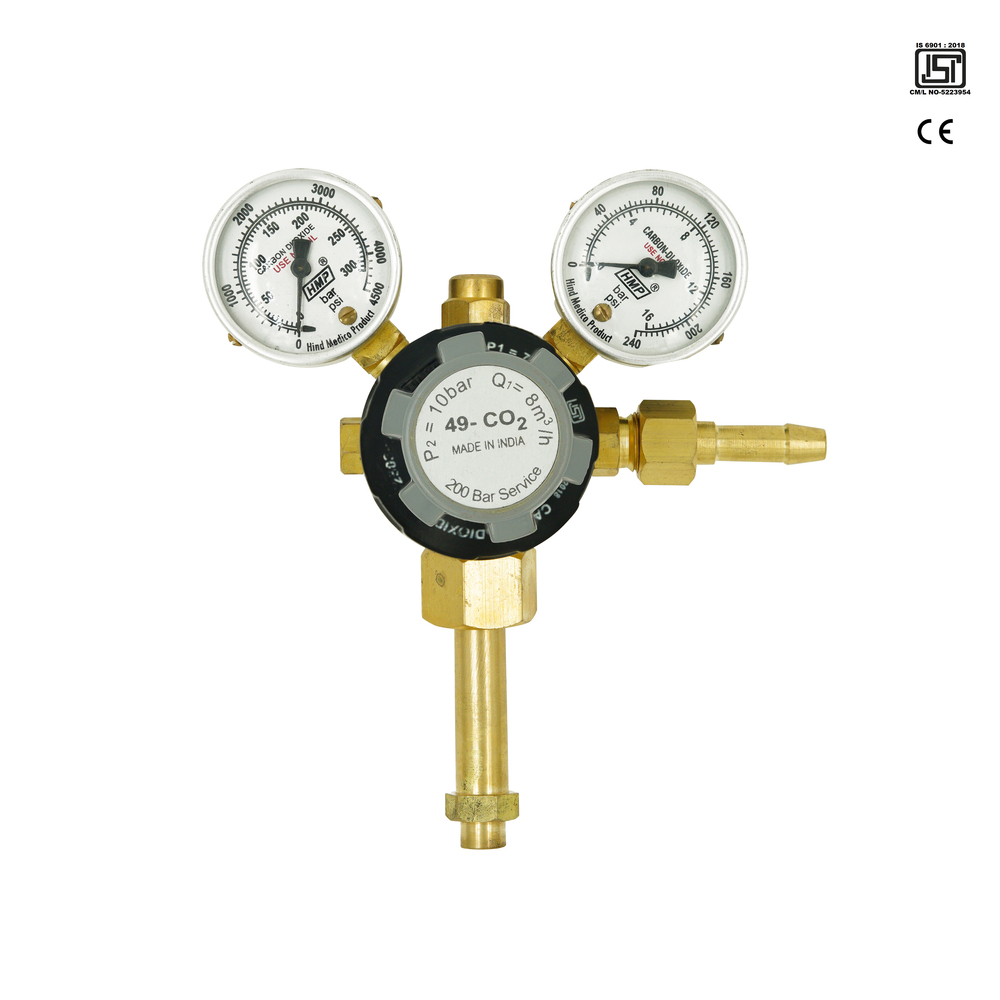
- Brass forging body
- Mazak pressure die-casting bonnet
- Silicon rubber diaphragm
- SS net inlet filter
- Dual safety pressure gauges
- In-built safety valve
- Continuous steady pressure & flow
- Use for Mig welding
- ISI Mark : IS 6901 / ISO 2503 & CE certified
MODEL | GAS | MAX INLET PRESSURE (bar) | INLET PRESSURE GAUGE (bar/psi) | MAX OUTLET PRESSURE (bar) | OUTLET PRESSURE GAUGE (bar/psi) | CONNECTION | MAX FLOW (m³/h) |
49-CO2 | CARBON DIOXIDE | 200 | 0 - 300 bar 0 - 4500 psi | 0 - 10 | 0 - 16 bar 0 - 240 psi | Inlet W 21.8 - 14 (RH)F Outlet 3/8" BSP (RH)M | 8 - 10 |
Unit conversion:
- 1 bar = 14.5 psi = 1.02 kg/cm²
- 1 m³/h = 16.67 LPM
Robust Performance and DesignOur 49-CO2 Gas Pressure Regulator boasts a maximum inlet pressure of 200 bar and a robust flow rate of up to 10 m3/h. Crafted from polished brass and copper, its design ensures long-lasting durability and resilience, even in demanding industrial environments. Mounted on cylinder tops, the standard-sized regulator provides a seamless and reliable interface for CO2 gas handling applications.
Precision and Safety with Dual GaugesDual gauge technology allows users to monitor both inlet and outlet pressures quickly and accurately. This feature enhances operational safety and helps maintain precise adjustment of gas delivery, making the regulator suitable for critical industrial processes that require exact CO2 output control.
Dependable Solution for Industrial CO2 ApplicationsDesigned exclusively for industrial use with CO2 cylinders, this regulator meets the high standards expected by manufacturers, exporters, and suppliers across India. Its polished brass finish and copper construction ensure resistance to corrosion while maintaining optimal performance in various industrial sectors.
FAQ's of 49-CO2 Gas Pressure Regulators:
Q: How should the 49-CO2 Gas Pressure Regulator be installed on a CO2 cylinder?
A: The regulator is designed for cylinder top mounting. Ensure the cylinder valve is closed, attach the regulator to the cylinder outlet using the provided threads, and tighten securely. Once attached, check the dual gauge displays for pressure readings before opening the main valve and adjusting the outlet pressure as needed.
Q: What is the process for adjusting the outlet pressure on this CO2 regulator?
A: After securing the regulator to the cylinder, slowly open the cylinder valve. Turn the adjusting knob or handle on the regulator to set the desired outlet pressure, which can be monitored using the dedicated outlet gauge ranging from 0 to 10 bar.
Q: When is it necessary to replace this gas pressure regulator?
A: Regular maintenance checks are recommended. The regulator should be replaced if there are visible signs of wear, corrosion, or if it fails to maintain consistent pressure or leaks occur during use. Follow manufacturer guidelines for scheduled replacement to ensure safety.
Q: Where can this CO2 gas pressure regulator be used?
A: This regulator is intended for industrial settings, including manufacturing plants, laboratories, and any processes that require controlled CO2 gas supply. Its robust construction and precise pressure control make it suitable for a wide range of demanding environments.
Q: What are the primary benefits of using a dual gauge CO2 pressure regulator?
A: A dual gauge system allows simultaneous monitoring of both inlet and outlet pressures. This enhances safety, allows for immediate pressure assessments, and helps users make precise adjustments to facilitate optimal gas flow for industrial applications.
Q: How does the material choice (copper and brass) benefit the regulator's longevity and performance?
A: Copper and polished brass provide excellent resistance to corrosion and mechanical wear. These materials ensure the regulator remains functional and reliable over extended periods, even when exposed to harsh industrial conditions common with CO2 gas handling.